

Online Climate Information Resources and Portals

Practitioners who deal with sea level rise, extreme heat, transportation planning, water management, electric utilities, and other practice areas have access to myriad online climate information resources and portals (online locations created to share information about climate and climate change in a variety of decision contexts). Yet it is often unclear how to find the appropriate resource, and it is often unknown how much these resources are being used and by whom. It is also difficult to assess whether and how seemingly similar portals differ from one another, especially in terms of the data they use to assess climate change impacts.
Investigation overview
For this investigation, we leveraged interviews and surveys from our other investigations, in which we asked participants to share which online resources they use. We also built upon AGCI’s existing database of climate change portals and the attributes we used to assess them. Our ever-evolving collection currently comprises over 150 online climate resources and portals, including those identified during our sea level rise and coastal planning (50), extreme heat mitigation and management (28), and transportation infrastructure planning (6) investigations.
We conducted an initial survey of the 84 practitioner-identified online resources to understand what climate change information they contain and if and how they provide decision support beyond data. In particular, we used our conceptual framework (Figure 1.3) to identify where online climate information resources are most aligned in supporting actions within climate change decision making and which types of impacts they are designed to help address.
We also did a desktop analysis of the underlying global climate model data sources in a subset of portals to better understand the diversity of model data and providers involved. In this evaluation, we used 15 online portals featured in A User Guide to Climate Change Portals.
Findings
Even if similar underlying climate change information was used, the ways in which climate change information has diffused is incredibly varied.
We discovered a diverse range in the types of data being shared as well as in the spatial and temporal scale of that data. While some portals and online resources focus on global models, others show hyper-local data downscaled to street or even home level. In some cases, climate information displayed includes projections far into the next century (2100s). In other instances, such as tide measures, information is shared for the current day.
Online resources focus on understanding and planning instead of implementation.
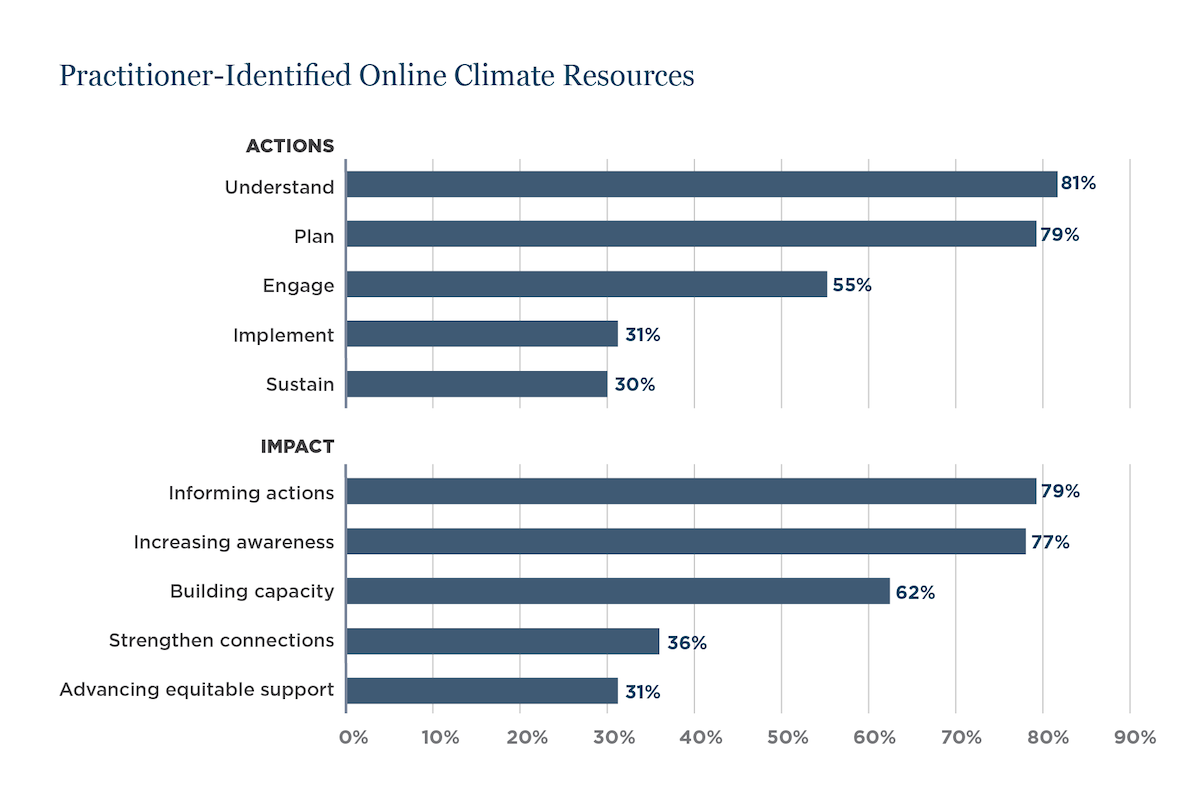
Of the 84 practitioner-identified online resources collected (Figure 2.7.1) in our initial evaluation, we found more focused on understanding (81%) and planning (79%) actions, whereas only a third focused on implementing (31%) and sustaining (30%) actions.
A third of the practitioner-identified online resources contained information that could explicitly advance more equitable support.
Of the 84 online resources identified by practitioners, our analysis categorized 31% as having content that could advance more equitable support in climate change decision making and 36% as containing information with potential to strengthen connections (Figure 1). Furthermore, a correlation analysis showed that resources focused on planning and understanding actions, while more abundant, were less likely to include information relevant to supporting communities with limited resources, while resources that supported implementing and sustaining actions were more likely to incorporate these considerations. This underscores the need for more resources — or greater awareness of existing ones — to consider communities’ priorities earlier, particularly communities with limited resources, in the process, as more attention from the outset would help solutions align with community priorities, needs, and values.
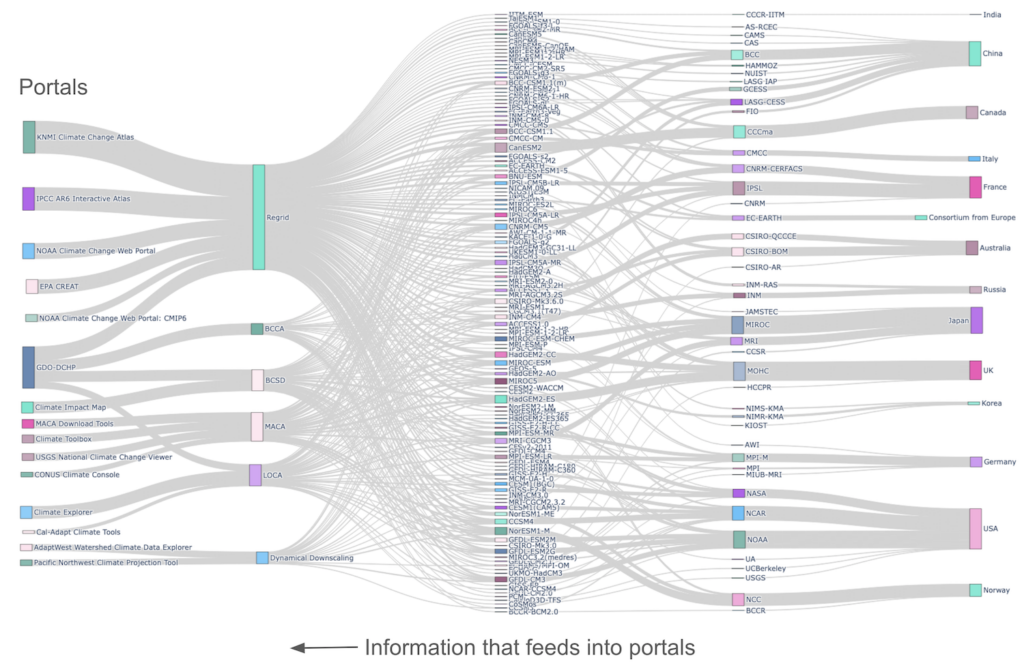
Online climate change portals commonly use ensembles of global climate models but the subset of models used and downscaling approach varies across portals.
The 15 climate change portals featured in A User Guide to Climate Change Portals all draw from ensembles of global climate models generated by supercomputers at research centers around the world. This coordination is largely possible because of the Coupled Model Intercomparison Project led by the World Climate Research Programme. Global model data for each portal, however, varies in how the coarse resolution data is translated to finer spatial resolution. While most portals use a single technique to downscale or regrid, the technique employed varies between portals, as does the subset of global models the technique is applied to. This means portals often report similar climate trends, but not identical estimates (e.g., increasing temperatures, more variable precipitation).
Recommendations from our exploration of online climate resources for improved climate change decision support:
- Improved navigation to existing online resources could allow more people to find the information they need and reduce duplication of efforts.
- If the goal is to support adaptation action, more emphasis should be placed on providing online resources to support implementation and sustaining actions (vs. understanding and planning).
- When developing online resources, more attention to communities, particularly those with limited resources, from the outset would help solutions align with community priorities, needs, and values.
- As the availability of climate information is constantly changing, a continuous effort (coordinated across many agencies and organizations) that tracks what information is where and how it should be used would enable more effective use.
For more information on this investigation, contact jvano@agci.org.


