Featured Publication
Archie, K.M.; Hirschfeld, D.; Meerow, S.; Arnott, J.C., Keith, L.; Vano, J.A., Mateo, E. Too hot to handle: Assessing practitioner climate service needs to advance heat resilience. https://doi.org/10.1016/j.cliser.2025.100606


Extreme heat, worsened by climate change and the urban heat island effect, poses major health and economic risks, especially for vulnerable groups like children, the elderly, and low-income households. Growing heat extremes reduce labor productivity and economic output, while increasing health risks to outdoor workers. Urban areas, particularly low-income neighborhoods, tend to face greater heat exposure. Addressing heat can involve reactive management actions like establishing cooling centers and educating the public on taking precautions during heat events. Proactive mitigation actions can include nature-based solutions to reduce temperatures in urban environments. But these kinds of efforts are often hampered by fragmented institutions, limited funding, and weak public support. Communities’ ability to adapt depends on resources, leadership, and effective climate planning, all of which may be aided by accessing and interpreting relevant climate change decision support.

Archie, K.M.; Hirschfeld, D.; Meerow, S.; Arnott, J.C., Keith, L.; Vano, J.A., Mateo, E. Too hot to handle: Assessing practitioner climate service needs to advance heat resilience. https://doi.org/10.1016/j.cliser.2025.100606
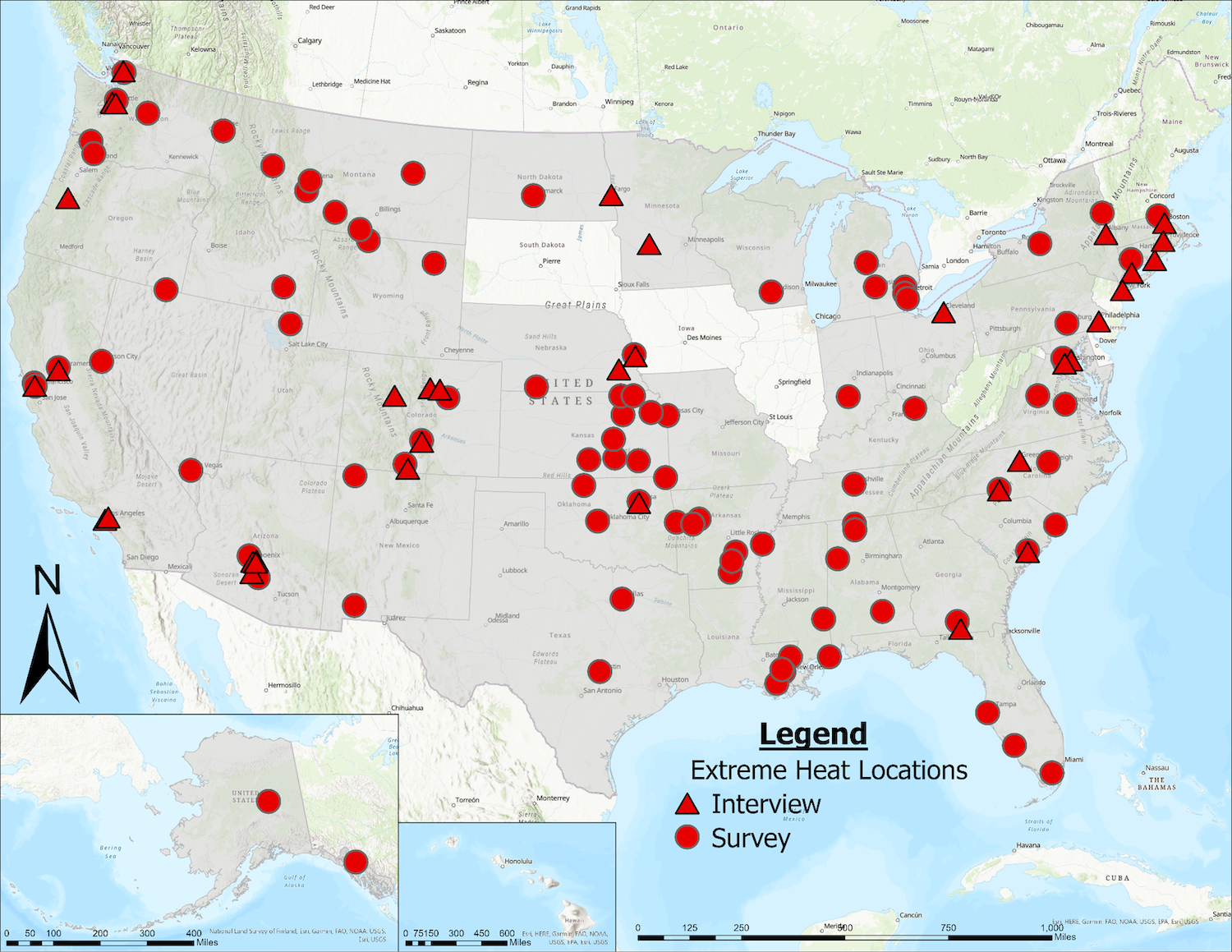
To assess how climate information is used in extreme heat decision-making and planning, this study employed a two-phase, mixed methods approach. In the first phase, group interviews were conducted with 38 heat practitioners from diverse U.S. regions, including areas like the Pacific Northwest and rural states, which are often overlooked in the study of heat preparedness. Participants, including heat officers and emergency managers, discussed challenges in integrating climate science into heat planning and highlighted 33 critical needs, which were categorized into information, decision support, and communication/education needs. In the second phase, a follow-up survey of 124 decision-makers ranked those critical needs in terms of their potential impactfulness and provided broader validation of the interview findings.
Similar to what was found in the SLR context, social and institutional challenges hinder adaptation to heat
Lack of perceived risk, lack of internal staff capacity, and lack of public understanding topped the list of challenges, highlighting the importance of effective and relevant communication tools for use with the public as well as the importance of educational programs aimed at improving understanding of extreme heat planning and response.

Practitioners are using climate information to both mitigate and manage heat, but are in need of additional information and a variety of other decision support tools
Our results find heat practitioners are already actively using different forms of information to support decisions and actions underway. Somewhat distinct from SLR practitioners, the heat practitioners we engaged with did not consider a glut of information or tools to be a problem. They were able to identify specific additional information and data needs, such as local-scale extreme heat data collection and regular on-the-ground monitoring, enhanced information and graphics on how extreme heat affects various systems, and a regionally specific heat index/heat rating.
“(We need a ) trusted service that could actually conglomerate that information together for us so that we can package it and really just focus on the communication piece as opposed to putting the information together. I think it’d be helpful to gain that public trust that we’re really looking for.”
— Extreme heat investigation participant
Significant differences in responses about “needs” between urban and rural respondents
Respondents from urban areas considered 12 of the 33 options to be significantly more impactful than rural respondents. Heat is often viewed as an urban problem, but the focus on urban heat may overlook the fact that rural areas can face greater heat-related mortality risks and typically have fewer resources, such as staff, to manage and mitigate heat. Lack of internal staff capacity was one of the top barriers to heat action. Providing heat information alone may not be enough for rural areas, as respondents indicated it would be less impactful due to limited local capacity.
Significant differences in responses about “needs” between participants with different levels of education
Our results suggest that additional education increases perceived salience of the issue, as respondents with educational attainment beyond undergraduate degrees considered 21 of the options to be more impactful than respondents with lower levels of education (as indicated by a large (>0.8) Cohen’s d effect size). Campaigns and programs to educate or train professionals about heat risks and response options could perhaps help to close this gap.
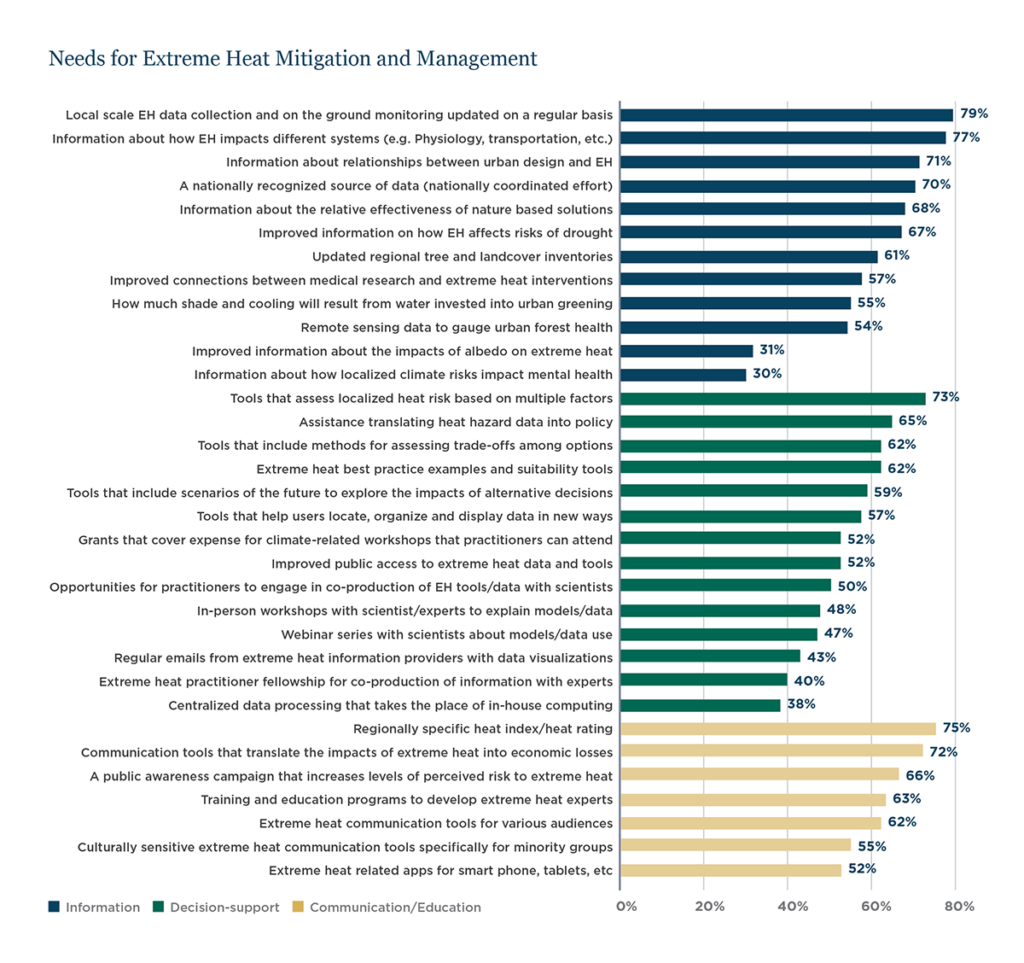
“Instead of giving me the data, show me what I can do with the data.”
— Extreme heat investigation participant
Recommendations from heat practitioners for improved climate change decision support:
For more information on this investigation, contact kelli.archie@agci.org.