The accelerating rate of sea-level rise (SLR) due to warming in the cryosphere and oceans puts millions of coastal residents at risk, highlighting the need for informed proactive adaptation. Coastal communities face increased flooding due to rising seas and precipitation, saltwater intrusion into aquifers, and the spread of contaminants. SLR also threatens coastal ecosystems, which are vital for food and livelihoods.
Addressing SLR requires significant adaptation efforts, often seen as a local responsibility to reduce risks to people and property. While much work has been done to assess these risks and local vulnerabilities, adaptation progress varies. Some areas have moved from planning to action, with regulatory changes and physical projects. However, challenges remain, including slow adoption of nature-based solutions, limited progress in underserved communities, and inconsistent plan quality.
Featured Publication
Hirschfeld, D.; Archie, K.M.; Mateo, E.; Arnott, J.C.; Vano, J. (2024). Practitioners’ Needs for Addressing the Challenges of Sea-Level Rise – A Qualitative Assessment. Earth’s Future, e2024EF004717. https://doi.org/10.1029/2024EF004717
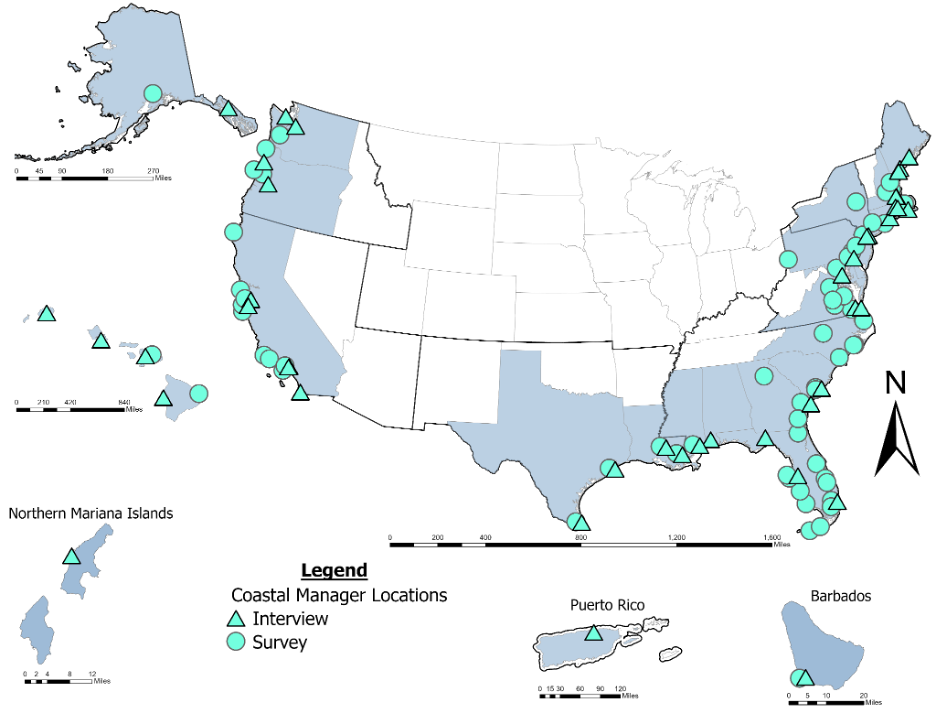
To better understand how climate information is currently informing decisions and what can be done to improve SLR-related decision support, we used group interviews and surveys of SLR practitioners. During the first round of data collection, our research team conducted a series of group interviews with 43 practitioners from 20 states, Puerto Rico, and the Mariana Islands, which represent all EPA regions with ocean coastlines. During the group interviews, we asked participants to provide specific examples of information, tools, or decision support resources that would allow them to more effectively make decisions related to SLR. Using the list of 38 participant-identified “needs,” we designed a survey that allowed a broader group of practitioners to weigh in on the level of impact each intervention would have on SLR planning and implementation. 117 practitioners from 23 states, Puerto Rico, and Barbados completed the entire survey.
Figure 1. Map showing locations of survey and interview participants. Shaded states and territories (in blue) contain the location of a participant. Bolded lines between states indicate EPA regions of the United States.
Key Findings
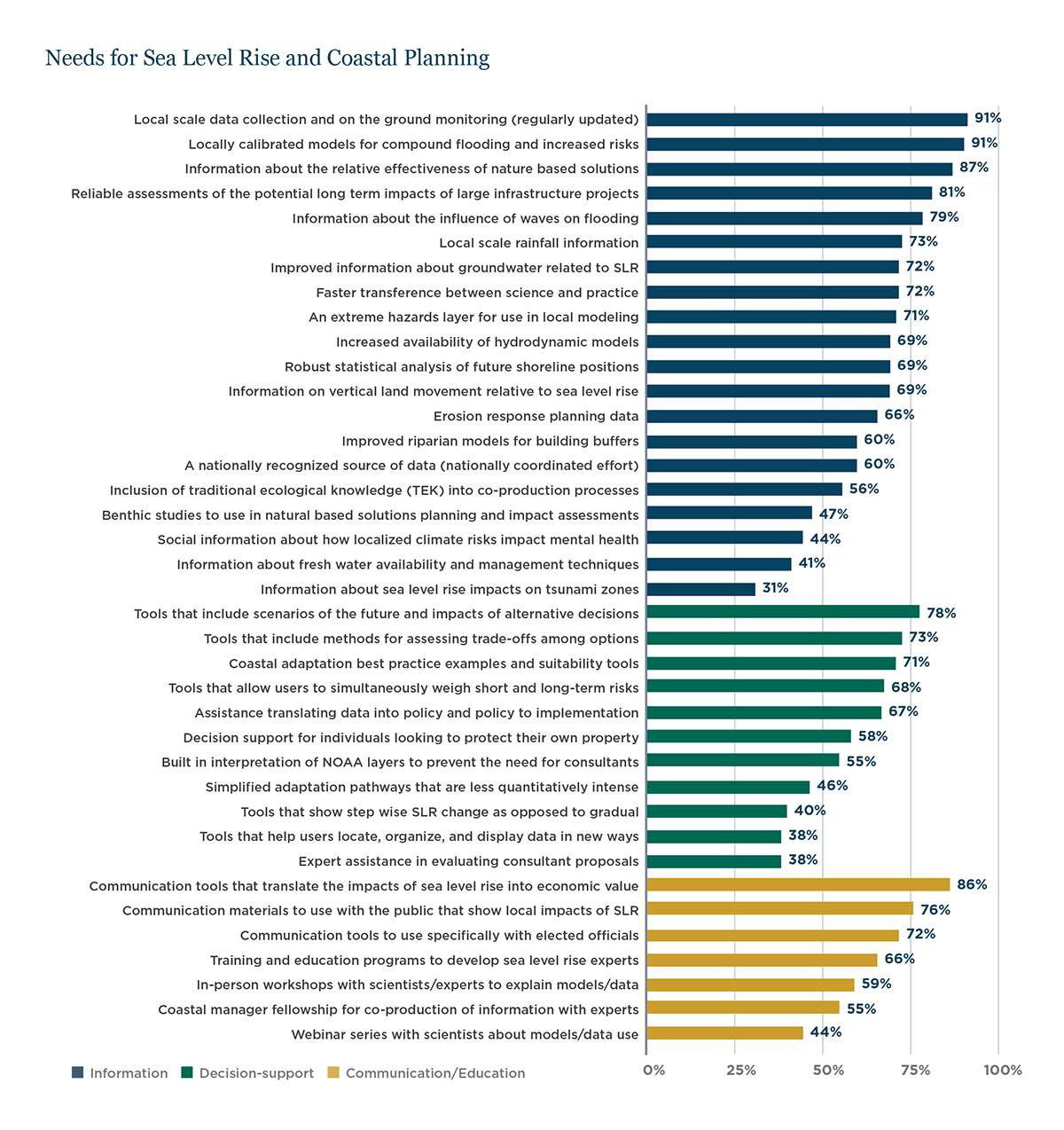
Sea level rise information is available and being used, but specific gaps remain. Practitioners in our study emphasized the need for specific information. They highlighted unmet needs such as local data collection, on-the-ground monitoring, and locally calibrated models that capture the compound impacts of SLR in combination with other climate hazards. These kinds of needs align with global research findings and reflect factors that enhance local adaptive capacity, like data availability and quality. Addressing these needs would shift climate services to a more demand-driven approach.
“… we have generally good data that is often very hard to translate into implementable policy.”
— SLR investigation participant
Decision support is needed. Practitioners expressed a need for more support in making complex decisions, rather than just more data. They struggle to translate available data into actionable policies and want tools that help evaluate future decisions, trade-offs, and risks over time. Many wrestle with balancing short-term needs against long-term risks. A deeper change is needed in how decision support tools are produced and sustained, with a focus on quality, practical implementation, and ensuring tools reach the local level. Building trusted relationships between those creating and using these tools could provide necessary decision support.
Figure 2. Percent of survey respondents who reported that the listed information needs, decision support needs, and communication tools and educational opportunities would be either very or extremely impactful.
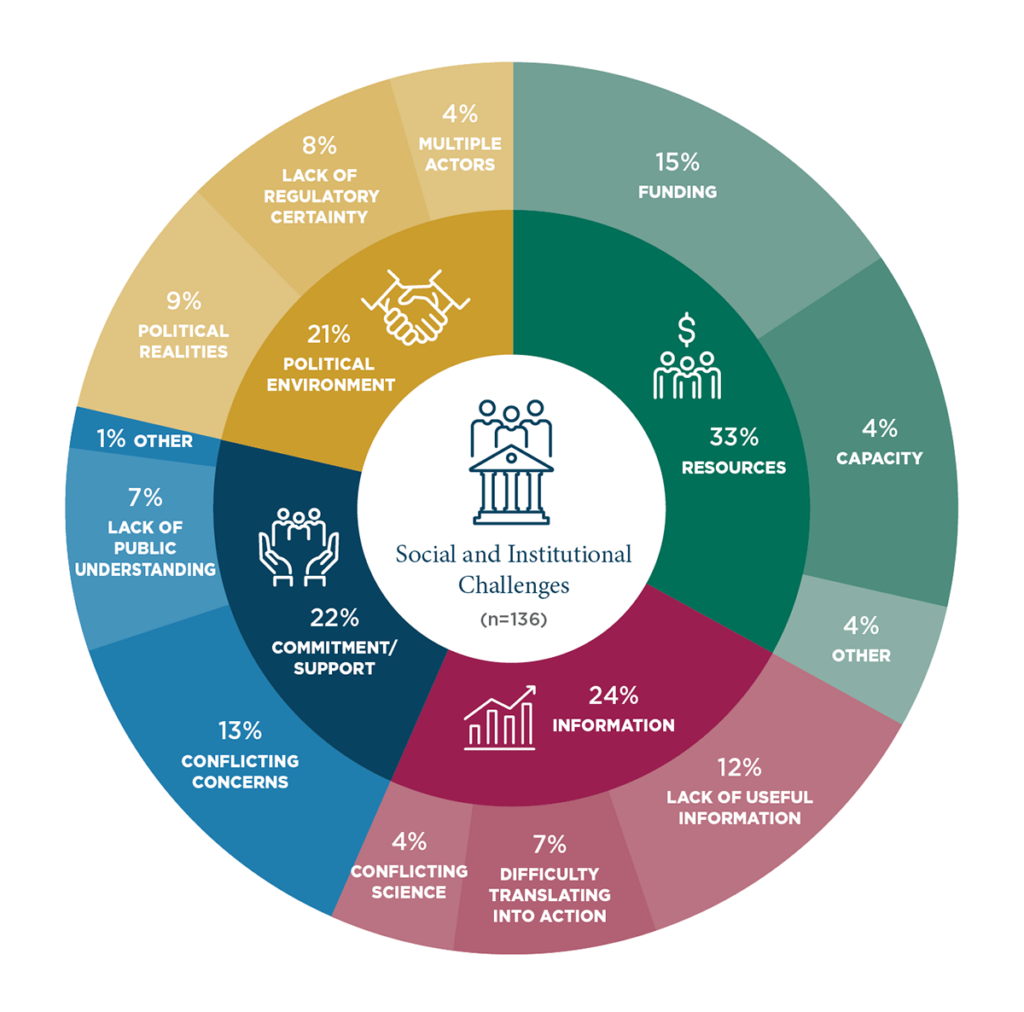
Challenges to adaptation are varied and widely distributed. The literature abounds with examples of barriers to adaptation, and our work with coastal managers highlights how varied and widely distributed the challenges are across different categories. Though resource-related challenges make up a third of the social and institutional challenges mentioned by our respondents, information-related challenges, those related to the political environment, and others that relate to the current level of commitment and support, are also significant (Figure 3).
Figure 3. A sunburst graphic depicting social and institutional challenges to SLR adaptation planning, as articulated by interview participants, in a hierarchical format. The inner ring shows four categories drawn from the literature: 1) Resources, 2) Information, 3) Commitment/support, and 4) Political-enabling environment. The outer ring shows a greater level of detail, providing a comprehensive visualization of the data.
“They want to develop a new tool, right? We got tools coming out of our ears! … I think there needs to be a big paradigm shift… if somebody develops a tool or creates a tool, those scientists should be responsible for implementing the tool, responsible for the tool getting down to the local level.”
— SLR investigation participant
Recommendations from coastal managers for improved climate change decision support:
Prioritize increased local-scale data collection and regular on-the-ground monitoring (e.g., tide gauges) alongside locally calibrated models. Additionally, efforts should focus on establishing a clear, nationally recognized source of SLR data, as local governments still face significant confusion despite existing interagency collaborations.
Improve decision support resources to better translate data into policy and action. Creating a clear repository of coastal adaptation best practices, paired with suitability tools to guide physical designs, would be highly beneficial. Additional support is needed to reduce reliance on consultants by building in-house capacity or providing resources for consultant use. Offering in-person workshops and one-on-one office hours with experts could further help practitioners address specific questions and navigate models or data sets.
Improved communication between scientists and various audiences, such as the public, policymakers, and practitioners, can address many challenges, including conflicting perceptions of risk and misunderstandings about climate change. Co-production is a valuable approach to overcoming these issues. There is a need for tools that translate SLR impacts into economic or locally relevant terms, as well as materials tailored for different audiences, including the public and elected officials.
Existing tools are only useful if staff can understand them, highlighting the need for more education and professional development. Programs should be created to build internal capacity for using available tools and communication resources.