

Increasingly business leaders, investors, and insurers are asking for physical climate information, and at times being required to incorporate it into financial planning, yet there are myriad ways this might be done. As a 2022 AGCI research review explains, businesses are actively considering two types of climate-related risks:
“First, risks related to the transition to a lower-carbon economy, including changing customer behavior, costs to adopt lower-emissions technologies, and increased exposure to litigation. Second, risks related to doing business in a changing physical environment, including increasingly severe extreme weather events, changing precipitation patterns, rising temperatures, and sea level rise. Both types of risk vary considerably based on business type, size, and location.”
For many in the climate change research community, the financial domain seems relatively opaque and unexplored owing to the often private and proprietary nature of business decision making. Also, at least until recently, there has been little engagement between climate research and finance communities.
Investigation overview
In 2022, CarbonPlan, the Environmental Defense Fund, and the Initiative on Climate Risk and Resilience Law convened a series of workshops and focus groups with former regulators and domain experts across physical science modeling, economics, financial risk, law, and public policy to discuss if and how physical risk information was currently being used, and to identify gaps, challenges, and concerns with the use of physical risk information. The effort focused on a particular case study: the financial risk of electric utilities impacted by extreme heat. Instead of launching a similarly aimed investigation, we participated in their process and provided feedback on the outcome report.
Key Findings
The report was released in July 2023. From the report, we highlight several key findings below. Note: text below are largely excerpts from the final report. We encourage the reader to link to the final report for more details.
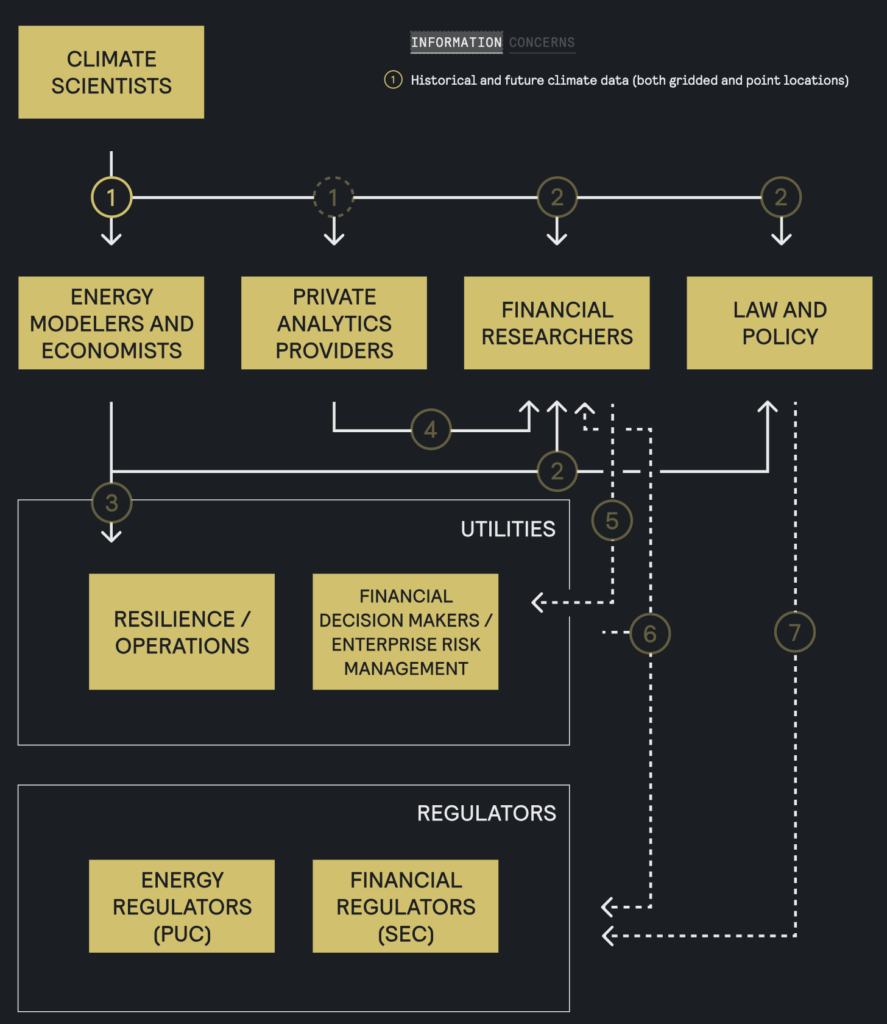
A conceptual model of the process and actors contributing to climate-related financial risk assessment
This model (Figure 1) documents current understanding, as of July 2023, of the financial risk assessment landscape to help identify strengths and places for improvement.
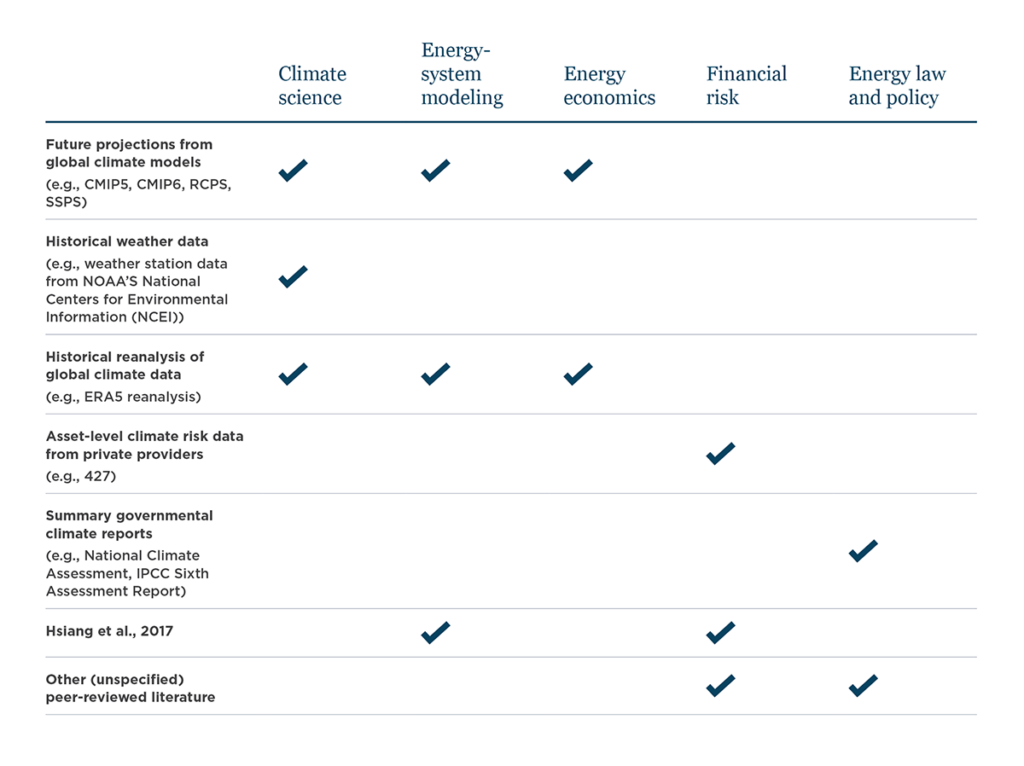
Communities within the finance sector use different sources of climate information.
Two modes of engagement with climate information were identified: (1) direct engagement between electric utility and domain experts and the climate science or energy system modeling communities, and (2) little direct engagement, but reports that were publicly available and proprietary data from private companies (for core analytical processes). More specifically, climate science, energy system modeling, and energy economics communities of practice report using raw climate model output and reanalysis data for analyses, while financial risk and energy law and policy communities of practice report using peer-reviewed literature and third-party risk scores (see Figure 2).
Institutional inertia and capacity constraints limit the use of future climate projections in the finance sector.
Workshop participants noted that substantial resources are required to assess and understand future projections. Risk assessment requirements or standards may be needed to help actors in the finance sector to justify developing the capacities to go beyond the norm of using only historical climate data.
Goal-setting can help identify appropriate data and clarify what risk means to different actors.
While all actors could experience the same event, goals can differ considerably (e.g., a financial analyst may be focused on a loss of investment principal, a utility on likelihood of blackouts, and a customer on affordable rates). More clarity and a standardized approach to goal-setting could help facilitate important communications among key actors.
Recommendations from the financial sector for improved climate change decision support:
- Numerous climate change information concerns would benefit from increased investment in scientific research to produce high-resolution, publicly available data products and open-source methods.
- Regulators could help alleviate discrepancies in the risk-assessment process by providing guidance to better standardize and improve analysis.
- Deeper, iterative engagement with actors throughout the analytic chain (Figure 1) could address the challenge of interpreting climate data sets, making them more usable as appropriate and decreasing the likelihood of misuse.
This work is closely tied to our climate analytics investigation, so we anticipate conversations that are a part of that investigation will help inform next steps. For more information, contact jvano@agci.org.