

New AGCI report maps the many ways society is learning to be more climate resilient
As climate change accelerates, practitioners, planners, and policymakers face increasingly complex decisions every day. Whether they’re helping communities prepare for rising seas, designing public health strategies to protect vulnerable populations from extreme heat, or redesigning transportation infrastructure to withstand more frequent flooding events, the stakes are high and the need for reliable, actionable climate information has never been greater.
To help address this challenge, AGCI launched a multi-year series of investigations to understand how over 400 practitioners across a range of sectors and settings access and use climate information in their work, and to identify how to better support their decisions and actions.
What is decision support?
At its core, decision support refers to the tools, processes, knowledge, and relationships that help people make informed choices—particularly when those choices are complicated by uncertainty, long time horizons, or multiple competing objectives. In the context of climate change, decision support can include everything from a regional workshop for water managers on climate resilience to localized sea level rise projections that inform coastal zoning plans to heat vulnerability maps that guide investments in cooling centers. More than just providing data, effective decision support is about delivering the right knowledge, in the most accessible way, to the people who need it, when they need it. It is also about how people work together and learn from each other.
Exploring real-world decision support needs

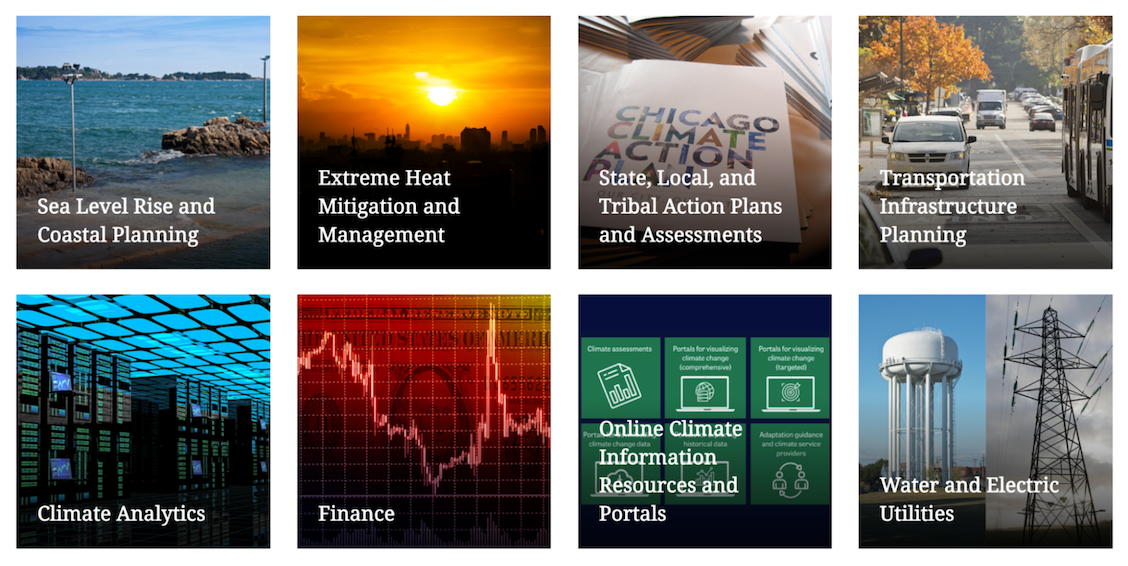
Starting in 2022, the AGCI project team embarked on investigations across a range of U.S. sectors, including sea level rise and coastal adaptation planning; extreme heat mitigation and management; state, local and tribal climate action planning; transportation infrastructure planning; climate analytics; financial services; and water and electric utilities. Through interviews, surveys, and document analysis, the project team gathered over 400 practitioner perspectives and reviewed hundreds of resources to illustrate what climate decision support looks like in different contexts and how decision making is affected by climate change — for business and industry, for government at all levels, and for individuals. The resulting report and project website present sector-specific insights as well as overarching findings, recommendations, and actions that bring together common themes across all eight investigations.
A framework for decision support
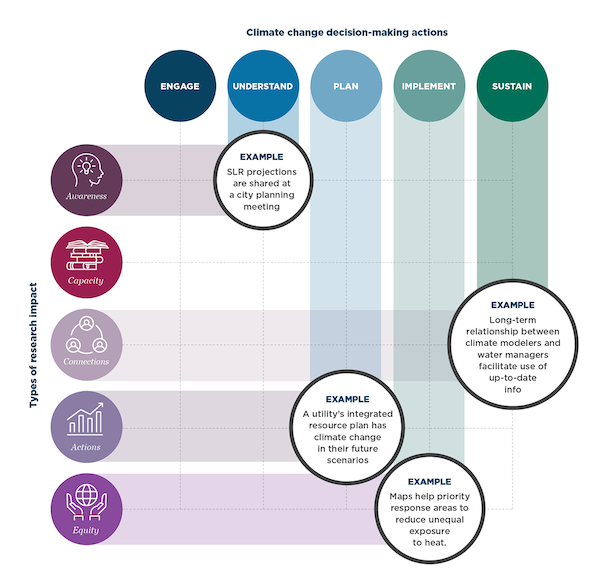
One of the project’s notable contributions is developing a practical framework that distinguishes distinct stages involved in climate-related planning and action and highlights that there is a variety of climate information that can be useful at each stage. By mapping decision-making actions against the different ways climate information can have an impact, the framework offers a more expansive way to recognize the value of climate information. Sharing sea level rise (SLR) projections at a city planning meeting, for example, may build awareness and improve the capacity of elected audiences to make sense of climate information, but those projections may not inform direct action since the implementation stage of a coastal zoning project has not yet begun. Alternatively, a water utility might use climate change projections to plan for the best actions to take under different possible future water supply conditions, demonstrating a more direct use of climate information to inform actions. Both uses are of value to communities taking action to advance their climate resilience.
Connecting to the broader landscape
The AGCI team also developed a conceptual map to help visualize the climate services landscape, a web of many and varied interconnected activities and actors involved in producing information, providing coordination, and pursuing continuous learning and innovation (see figure below).
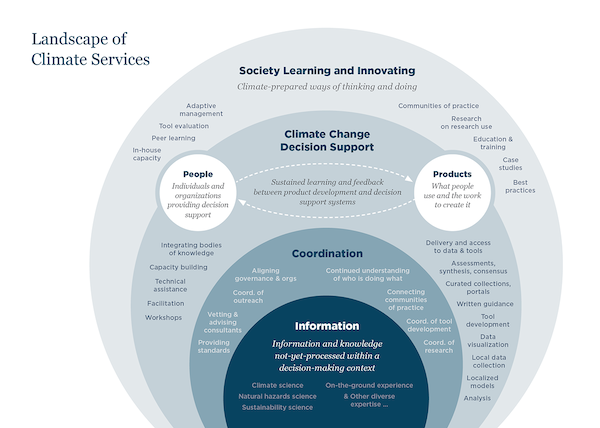
“This conceptual map represents how we’ve come to think about the dynamic terrain of climate decision support,” says Dr. Julie Vano, project principal investigator and AGCI’s Research Director. “It helps illustrate how the people, products, and processes that provide climate services could interact and reinforce each other. By providing this big-picture view, we hope to help those working to support planners and practitioners better see where their efforts fit and where new tools and connections could best support decision-making.”
Next steps
Together, the decision support project’s findings, frameworks, and conceptual tools offer valuable insights and recommendations for advancing more effective, climate-ready decisions across sectors and communities. The project is already contributing new insights and recommendations to the field, including the publication of three peer-reviewed papers: two assessments of practitioner needs, one focused on coastal planning for sea level rise and the other on extreme heat mitigation, and a third paper on the use of climate information in transportation planning.
This project also inspired work that is currently underway focused on understanding the value of climate adaptation case studies to enhance peer learning and accelerate resilience.
Learn more and explore the final report and other project outcomes at AGCI Decision Support Project.
An earlier version of this blog post was shared on July 8, 2025.