

Trade-offs between fire management and public health: Where do we go from here?
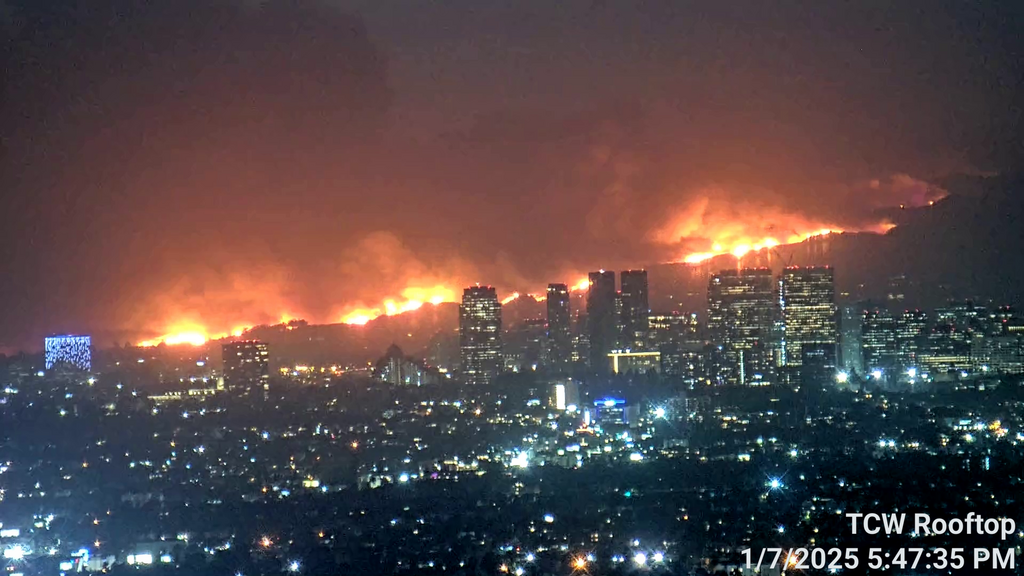
The first weeks of 2025 saw a series of devastating fires in Southern California. Fueled by severe Santa Ana winds and prolonged drought conditions, the wildfires — which are still smoldering, as new ones ignite — collectively scorched over 40,000 acres, destroyed more than 15,000 structures, and claimed at least 28 lives.
Wildfire and smoke impacts on both forests and communities are changing and growing rapidly compared to the twentieth century. In 2020, when wildfires decimated communities at the wildland urban interface (WUI) across the western United States, close to 18,000 structures were destroyed — 6000 homes in California alone. Even the relatively mild 2023 wildfire season destroyed over 4000 structures.
With increasing wildfire activity, more people are being exposed to dangerous levels of air pollution from wildfire smoke. According to a recent paper in Atmospheric Environment by G. Roberts and M.J. Wooster, smoke from wildfires around the world has exposed 44 million people annually to ”unhealthy” air (PM2.5 > 55 μg/m3). Another four million people are exposed at least one day per year to air that is considered ”hazardous” to health (PM2.5 > 250.5 μg/m3). These exposures result in the premature deaths of over 670,000 people annually, over a third of whom are children under age five. Additionally, vulnerable communities like the elderly, children, those with comorbidities, and outdoor workers in agriculture, construction, and natural resource management, continue to face higher rates of smoke exposure.
Climate change has led to an increase in both fire intensity and fire severity. While these terms are often used interchangeably in lay contexts, in research, they actually describe different phenomena. As J.E. Keeley describes in the Encyclopedia of Ecology (2008), “Fire intensity describes the energy released from the fire or characteristics of the fire behavior such as flame length and rate of spread. Fire severity refers to the ecosystem impacts of a fire such as mortality of trees or loss in biodiversity.”
A history of suppression
Fire exclusion and wildfire suppression have been the norm for forest managers in the Western U.S. for the last century. Combined with climate change, these management techniques have led to wildfires with more severe impacts to the environment and to humans. In a 2024 publication in Nature Communications, Mark R. Kreider and colleagues characterize the existing “fire suppression paradox”: that by putting out fires today, we make fires harder to put out in the future. This is because more regular fire on the landscape would result in forests with greater spacing between tree canopies, less undergrowth (or ladder fuels), and more patchwork forest structure with natural fire breaks. Without fire on the landscape, forests become denser, with a more homogenous structure that makes large-scale and high-intensity fires more likely and harder to suppress.
The authors call out the “suppression bias” that has emerged in the mainstream psyche as a result of a century of fire suppression. Because suppression efforts are more successful at extinguishing low- and mid-intensity blazes, our society is not experiencing low-intensity fires and thus, the prevailing public perception of fire is skewed toward the most severe and destructive fires.
A new era of management
In recent years, more forest managers have moved away from one hundred percent suppression toward mixed management techniques, such as mechanical fuel reduction, prescribed fires, ecosystem restoration, and a combination of these techniques. Through modeling various suppression scenarios, Kreider’s team determined that a “progressive suppression” technique (allowing more low-intensity fires to burn) could be a better approach to forest and wildfire management. This approach would not only lessen the impact of “suppression bias,” but modeling also demonstrated that area burned doubled much more slowly in response to climate change when compared with higher suppression scenarios. While it would not stop all high-intensity, destructive fires, it would curtail some, allowing time for people and forests alike to adapt to climate change.
Assessing the effectiveness of these alternate management approaches at reducing high- severity fires is difficult, due to minimal overlap between documented treatment areas and subsequent fires. In a 2024 publication in Fire Ecology, Emily G. Brodie and colleagues analyzed the impacts of the 2021 Antelope Fire (over 140,000 acres in northern California) on a 20-year-old silvicultural experiment that tested a range of thinning and burning treatments. This natural experiment demonstrated that the combination of thinning and prescribed burning resulted in greater forest resilience to the fire.
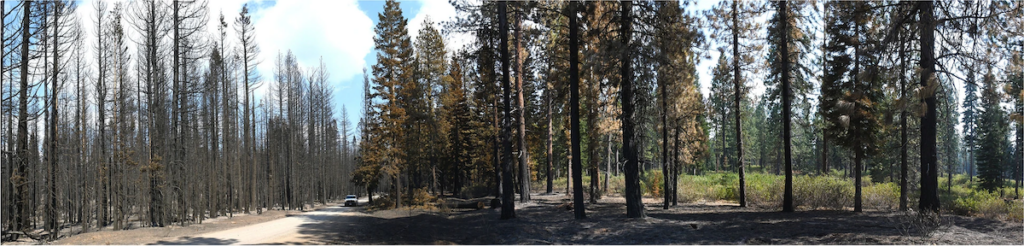
As the Antelope Fire took place amid multiple weather scenarios, the authors were also able to conclude that the combined treatment techniques were effective in variable fire weather conditions. These findings on the effectiveness of combined treatments are echoed by Kimberley T. Davis and colleagues in their 2024 Forest Ecology and Management meta-analysis of different forest management treatments subsequently impacted by wildfires across various forest types in a variety of fire weather scenarios in the western U.S.
The forest response to the Antelope Fire, 20 years after treatment, demonstrates the varied timelines that these treatment plans often work on and the challenge of assessing treatment efficacy. Even if increased prescribed burning (or less suppression of low-intensity wildfires) leads to fewer high-severity and high-intensity fires and less smoke in the long term, in the short term, prescribed fires often result in some smoke exposure for people in nearby communities.
Public health advocates and organizations have often argued that mechanical treatments, such as thinning or logging, should be used instead of prescribed burning to avoid any exposure to additional smoke. However, thinning and logging are not nearly as effective at reducing the severity and intensity of wildfire as a mixed-management approach that includes fire. Logging and thinning are also expensive, impractical at scale, and not always beneficial, depending on the forest type. Additionally, as Park Williams recently discussed in a public lecture, in the current climate working against a century of fire suppression policies, the fuel load on the ground needs to be dealt with, and the best way to reduce that is by getting more fire on the ground.
Public health tradeoffs
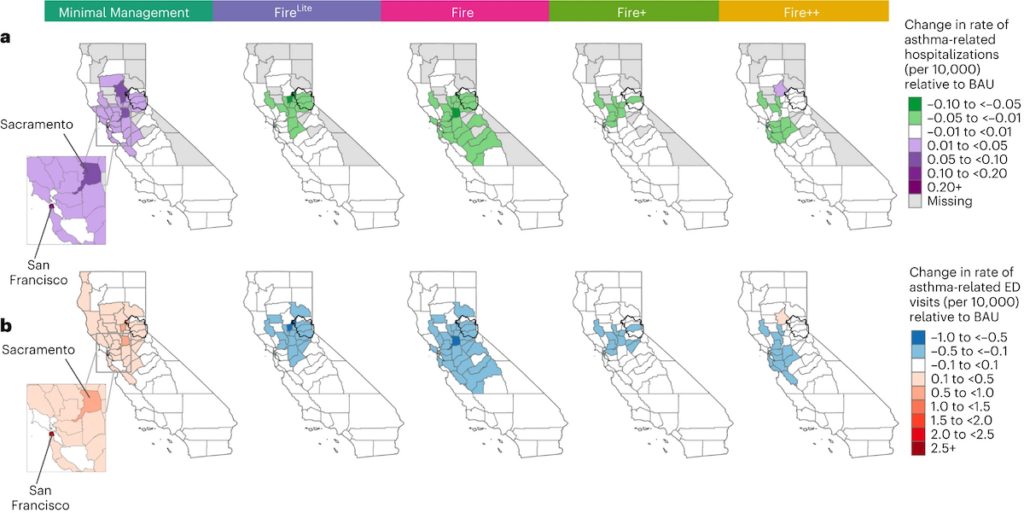
In a recently published analysis in Nature Sustainability, Claire L. Schollaert and colleagues take this trade-off into consideration with a modeling experiment to quantify the emissions of six different forest management scenarios in California’s Central Sierra. Utilizing a new methodological framework, the authors compared estimates of wildfire and prescribed burn-specific smoke levels for the six treatment scenarios with community smoke exposures to estimate health impacts. Compared to a business-as-usual scenario (16,000 hectares/year of mechanical thinning), they found that adding moderate levels of acreage burned with prescribed burning leads to the greatest benefit of reducing wildfire smoke exposure while also minimizing exposure from the prescribed burn. Additional burning above this moderate amount begins to have deleterious impacts on public health. These moderate scenarios above business-as-usual also reduced the wildfire season by approximately one month.
Forest management and public health timelines are not aligned. Smoke exposure can impact health and community decision-making on the scale of hours to days, whereas forest managers and ecologists think years to decades into the future. While acknowledging that increasing prescribed burning may lead to fewer high-intensity fires in the long run, a 2024 study by Andrew Rosenberg and colleagues in Earth’s Future models the public health impacts of increasing exposures from prescribed fire alone. This model includes the impact of wildfire smoke but does not account for potential reductions of wildfire smoke stemming from increased prescribed burning. Due to unpredictable timelines and spatial uncertainty in treatment/wildfire overlaps, this study and its findings present a realistic scenario in which the reduction of wildfire smoke anticipated from increased prescribed burning has not yet materialized. The model measures the annual total number of days with smoke from prescribed burns in high-priority and high-populated regions identified by CALFIRE as high risk for wildfire.
This future scenario shows a lower than historical concentration of smoke, but a higher number of smoke days, leading to an increased health burden (measured in cardiorespiratory emergency department visits), especially in densely populated regions. In California and other states that are looking to increase prescribed burning, this is a future we should be prepared for.
A 2023 retrospective study by Makoto M. Kelp and colleagues in Earth’s Future shows that increased prescribed burning would have lessened the smoke burden in Western U.S. environmental justice communities during intense 2018 and 2020 fire seasons. These results are particularly significant in Northern California, Oregon, and Washington, which saw an estimated 21 μg/m3 reduction in monthly average particulate matter (PM2.5, the most prevalent pollutant in wildfire smoke) in September 2020, but only a 1.5 μg/m3 reduction in other Western states. While this finding helps focus efforts on more prescribed burning in these coastal Western states, the results are limited by the fact that the model knew where the wildfire would occur. Many risk models have been developed to estimate regions at high risk for high-severity and/or high-intensity wildfire. Unfortunately, there are many barriers, including staffing and air quality regulations, that limit the implementation of treatment at the scale needed to cover all of these high-priority regions.
A recent Environmental Protection Agency study by James L. Beidler and colleagues published in ES&T Air found that on all United States Forest Service lands across the U.S., only 6.2 percent of land treated by prescribed fire between 2003 and 2022 encountered a subsequent wildfire between 2004 and 2023. The encounter rates with subsequent wildfires increased in the Western U.S. and increased with longer time intervals. The overall encounter rate by area increased to 14.4 percent with a 15-year interval, and with this interval was up to over 80 percent in two specific California forests. The assumption would be that with more time, this encounter rate would continue to increase. However, the previously mentioned review by Davis and colleagues found that treatments older than 10 years are less effective than more recent treatments, reducing effectiveness (measured in reduced wildfire severity) by 38 percent. These results vary by ecosystem and forest type and are admittedly difficult to generalize.
Protecting human and forest health
With so many tradeoffs, it is difficult to know how to move forward. Many prescribed burns are conducted in regions where communities are far away, and they must be conducted during favorable weather to send the smoke straight up rather than out. To protect communities from wildfire, more management needs to be done closer to population centers. Improving advance warning to impacted communities and giving them tools to create smoke-ready spaces could reduce health impacts. While there is agreement that improving smoke readiness is necessary, it is an open question in most communities as to whom this responsibility falls on, and the ball is often dropped.
In early 2020 — before the catastrophic fire and smoke season that year — the Wildland Fire Leadership Council requested that the U.S. Environmental Protection Agency (EPA), U.S. Forest Service, the Department of the Interior, and the National Institute of Standards and Technology conduct an assessment of air quality and health impacts of prescribed fire compared to wildfire. The CAIF report was released just over a year later as a set of future guidelines. While the assessment marked these separate agencies — with very distinct agendas — coming together to find common ground, the main takeaway from the report is that more work is needed:
“These areas of additional research include enhanced air quality monitoring capabilities for wildfire smoke, better characterization of wildland fire smoke exposures for health studies, additional understanding of the health effects of wildfire smoke over many seasons, and a fuller accounting for the role of public health actions and interventions in reducing or mitigating wildland fire smoke exposure.”
In 2023, the Biden administration pushed this work further through the signing of a Memo of Understanding between the U.S. Department of Agriculture, EPA, U.S. Department of the Interior, and the Centers for Disease Control and Prevention to address wildfire risk and protect communities from smoke.
More work is needed on both research and implementation. While agencies are working to develop guidelines and come to agreements moving forward, on-the-ground practitioners need additional support navigating changing regulations and staffing issues, among other responsibilities. As fire and smoke affect more communities each year, we need to find a way to coordinate unaligned timelines and better prepare for the impacts to both forests and people of changing fire dynamics on the ground.
Featured Research:
Beidler, J.L., Baker, K.R., Pouliot, G. & Sacks, J.D. (2024). Encountering prescribed fire: Characterizing the intersection of prescribed fire and wildfire in the CONUS. ACS ES&T Air 1 (12),1687-1695. https://doi.org/10.1029/2022EF003468.
Brodie, E.G., Knapp, E.E., Brooks, W.R., Drury, S., & Ritchie, M.W. (2024). Forest thinning and prescribed burning treatments reduce wildfire severity and buffer the impacts of severe fire weather. Fire Ecology, 20, 17. https://doi.org/10.1186/s42408-023-00241-z.
Davis, K.T., Peeler, J., Fargione, J., Haugo, R.D., Metlen, K.L., Robles, M.D., & Woolley, T. (2024). Tamm review: A meta-analysis of thinning, prescribed fire, and wildfire effects on subsequent wildfire severity in conifer-dominated forests of the Western US. Forest Ecology and Management, 561, 121885. https://doi.org/10.1016/j.foreco.2024.121885.
Kelp, M.M., Carroll, M.C., Liu, T., Yantosca, R.M., Hockenberry, H.E., & Mickley, L.J. (2023). Prescribed burns as a tool to mitigate future wildfire smoke exposure: Lessons for states and rural environmental justice communities. 11(6). https://doi.org/10.1029/2022ef003468.
Kreider, M.R., Higuera, P.E., Parks, S.A., Rice, W.L., White, N., & Larson, A.J. (2024) Fire suppression makes wildfires more severe and accentuates impacts of climate change and fuel accumulation. Nature Communications, 15, 2412. https://doi.org/10.1038/s41467-024-46702-0.
Roberts, G., & Wooster, M. J. (2021). Global impact of landscape fire emissions on surface level PM₂.₅ concentrations, air quality exposure, and population mortality. Atmospheric Environment, 252, 118210. https://doi.org/10.1016/j.atmosenv.2021.118210.
Rosenberg, A., Hoshiko, S., Buckman, J. R., Yeomans, K. R., Hayashi, T., Kramer, S. J., et al. (2024). Health impacts of future prescribed fire smoke: Considerations from an exposure scenario in California. Earth’s Future, 12, e2023EF003778. https://doi.org/10.1029/2023EF003778
Schollaert, C.L., Jung, J., Wilkins, J., Alvarado, E., Baumgartner, J., Brun, J., Isaksen, T.B., Lydersen, J.M., Marlier, M.E., Marshall, J.D., Masuda, Y.J., Maxwell, C., Tessum, C.W., Wilson, K.N., Wolff, N.H., & Spector, J.T. (2024). Quantifying the smoke-related public health trade-offs of forest management. Nature Sustainability 7, 130–139. https://doi.org/10.1038/s41893-023-01253-y.
U.S. Environmental Protection Agency. (2021). Comparative assessment of the impacts of prescribed fire versus wildfire (CAIF): A case study in the Western U.S. (EPA/600/R-21/197). U.S. Environmental Protection Agency.
Williams, P. (2024, October 22). Why have we lost control of wildfire in the western United States? [Public lecture]. Aspen Global Change Institute.
Dr. Savannah D’Evelyn is an environmental health scientist and bio-social scientist with expertise in environmental toxicology, community-based participatory research, climate adaptation, and implementation science. Her work centers on understanding the impacts of climate change on communities. Dr. D’Evelyn received her PhD from the University of California, Davis with a dissertation on the respiratory health impacts of air pollution. As a postdoctoral fellow at the University of Washington, Dr. D’Evelyn’s work focuses on how smoke from prescribed fire and wildfires impacts communities. She utilizes community based participatory research and collaborative interdisciplinary approaches to work across forestry, climate, air quality, and health disciplines to move toward both fire- and smoke-ready communities.